


Two years ago, I wrote at length about the difficulty in scaling artillery shell production from 28,000 rounds per month at Scranton Army Ammunition Plant (SCAAP). To support Ukraine, allies, and the US’ own consumption, the Army had a not-so-secret plan to scale production to 100,000 rounds per month that they unveiled in 2024.
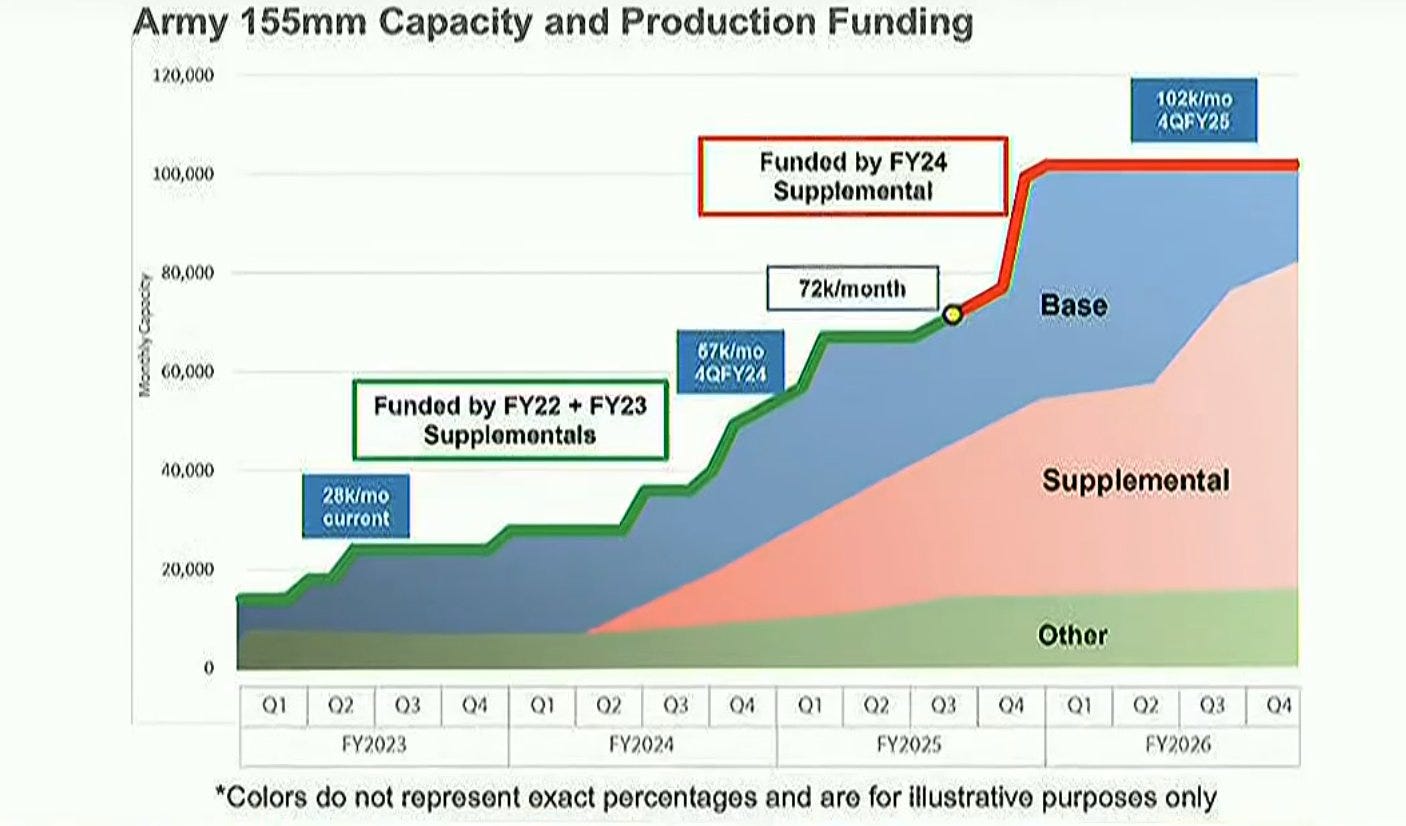
That plan has failed, though it made significant progress. Why it failed to reach its target is a fascinating case study of risk-taking in production technology. On July 9, 2026, the Office of the Inspector General published report DOWIG-2026-095 stating:
The DoW increased its capability and capacity to produce 155-mm artillery ammunition but did not reach the 2025 National Defense Industrialization Strategy Implementation Plan goal of 100,000 rounds per month by October 2025. As of March 2026, the Army had increased its monthly production from 14,000 to 36,000 rounds because of expansion and modernization efforts at both the projectile metal parts and the load, assemble, and pack facilities. However, at a contractor-owned, contractor-operated facility in Mesquite, Texas, the contractor has been unable to produce any projectile metal parts that meet contract specifications. The Army planned for the Mesquite Texas facility to produce 30,000 rounds per month. With only three facilities producing the required projectile metal parts, the DoW will reach only 71,000 rounds per month or 71 percent of its monthly production capacity goal for 155-mm artillery rounds. The Army’s expenditure of $469 million to establish the Mesquite facility could have been used to address other Army or DoW priorities.
This occurred because officials at the Army’s Capability Program Executive Ammunition & Energetics issued the contract and accepted the risk associated with purchasing and adapting unique production equipment which had not been proven to meet U.S. specifications.
Emphasis added.
There is a lot to like here. Notably, the US Army made a few different bets and more than doubled capacity. The US Army also took a risk on a new technology, and risks sometimes do not work out.
Risks should be judged on the quality of the decision making that went into taking them. Unfortunately, this risk seems poorly conceived. ProPublica talked to ex-workers to get the details: Fiasco in the Factory: Taxpayers Funded a $533 Million Artillery Plant That Made Nothing. I recommend the piece in detail, but I wanted to share a few high-level thoughts about why this was so poorly conceived and how it demonstrates the fundamentals of production.
Test, then produce.
General Dynamics pitched the Universal Artillery Projectile Line (UAPL) in Mesquite, TX as a step-change in manufacturing. Those other factories the US opened for artillery shell production would use the same process as the Scranton Army Ammunition Plant—hot forging, a known, established process for making exactly what is needed today. Rather than a hot forging process suitable for only a few sizes of artillery shells, the UAPL would use a new kind of manufacturing technology that allows for any size of shell (hence, universal). The technology itself is called flow forming, a proprietary technology from the Turkish defense contractor Repkon. Details on it are still a little scarce, but from what I can gather it attempts to heat and form metal continuously rather than in sequential steps. Repkon’s material presents the benefits as improving cycle time and less material waste.
ProPublica states that it had been used to make artillery shells successfully; however, not with our old friend HF-1, the specialty steel the US developed in the 1970s with Bethlehem Steel. All prior parts were made with older, commodity steels that are still effective but do not meet the Army’s specifications. Given the urgency of the supply shortage, General Dynamics urged the Army to jump straight into production with this new manufacturing technology, allegedly with Congress waiving many of the procurement guidelines that would have more deeply probed the potential and suitability for the application.
“The Army could have balked at all of this and insisted on learning more about the capacity of the Repkon machines to perform the desired work. But learning more would’ve taken time, and time seemed in short supply. “There was incredible pressure to go fast,” a former Army official said. Everybody moved forward.
…The factory’s signature device, meant to precisely stretch the steel for the artillery shells, instead often cracked it beyond repair…
As someone who has called for more urgent answers to these shortages, I applaud Congress and the Army’s willingness to take decisive action here. Let me attempt to steelman a situation where this makes sense. Imagine it would take 3 years to get a new forge and press line, but you could have this new solution in 1 year. Why not build a facility around the new tech and give yourself an option? If the new tech works, cancel the order. If it doesn’t, rip and replace the tech. In fact, later in the article when pressed to defend the decision, the decisionmaker at General Dynamics (more on him soon) defended it as “fast”. While that seems to be the current arc of the factory, this story deserves skepticism simply because at no point during the opening did they present any of this as an experiment.
Apparently, at no point did they check how the new process would work with HF-1 until the machines were on the production line. Presumably, they checked the spec sheet of the machine, compared it to the processing plan required for HF-1, said it was good enough, and placed a huge order.
“The Army made the most of its expanded powers, awarding General Dynamics a number of UCAs without considering alternate proposals in a competitive bidding process. (The Army told ProPublica it selected the company because of its unique artillery production experience.)...
…Crucially, before greenlighting the deal, the Army did not require General Dynamics to demonstrate that it could use the Repkon equipment to complete the entire production process and make shells that met the Army’s specifications. (The Army told ProPublica that “formal testing could not occur prior to full machinery installation.”)”

Admittedly, I was screaming internally while reading this part. This approach is plausible in a crisis, but it is crazy as your only approach! Ask them to try building a few on an existing line! They must have a prototype line somewhere–demonstrate capability! You are not recreating the Manhattan project, you are recreating building 300,000 airplanes! Expect an iterative, cumulative approach to meeting quality, schedule, and cost goals with new production techniques.
Slow is Smooth, Smooth is Fast
Videos of SCAAP show a relatively manual factory, made over a century ago and now a historical site preventing expansion. UAPL aimed to correct that with an automated line—in fact, 3 identical automated lines. Designing a line from scratch in 2026 allows manufacturing engineers to add many new proven automation tools that help track, transfer, inspect, and qualify work articles. Combined with the new flow forming technology, it would jump straight to the forefront of manufacturing.
ProPublica shares worker stories of how completely out of control their automation system is.
The robots, giant metal arms with clamps for hands, would end up drenched in oil, which would then — no surprise — combust as they moved steel blocks heated to 1,800 degrees into and out of a machine that periodically erupted columns of fire. One blaze that summer melted a robot’s cables, putting it out of commission for a week…“After the second, third, fourth time, it just became almost normal,” one former worker said. “It got to the point where I was not surprised by anything that happened there.”
The systems are simply unbelievably unsafe and poorly implemented:
“…Soon problems seemed to explode out of every corner, according to interviews with 12 former factory workers. For one thing, the flaming robot arms also kept smashing into things. They slammed into computer numerical control machines, breaking their windows and bending their doors. They knocked over shells. They bashed into safety fences. Workers talked about the arms going “rogue” and began calling one of them “Johnny 5” after a sentient military robot from a 1980s movie.”
It seems they often had no recourse but to try to get the robots to work, leading to some curious rituals:
“We really didn’t have any standardized practice,” said Quantel White, a former employee. “It was just a bunch of guys taking turns going at the machine with a sledgehammer every night.”
Anyone with a passing familiarity of the Musk algorithm knows how this goes awry. The algorithm is: question requirements, delete parts/processes, simplify/optimize, accelerate cycle time, and automate last. Trying to automate a new production line first pours technology risk on top of technology risk. Did the machine run for the right amount of time? What parameters was it supposed to run at? Were those calibrated? How were they calibrated? What consumables are involved? Was it the same batch or different? Running the line manually to begin with allows for complete control and the accumulation of tribal knowledge of each step of the process and eventually familiarity with machines, building towards a holistic view of what impacts quality the most and where automation will help vs. hurt. It is possible General Dynamics attempted this, but given the line is producing nothing, it is difficult to believe they did or else they would have some lower level of production to fall back to.
Bet on 0 to 1
What separates good from bad in most human endeavors is leadership. At the heart of the story is Firat Gezen, the leader of the General Dynamics business unit responsible for artillery shells. Notably, Gezen has no background in engineering or manufacturing. He operated SCAAP and presented flow forming as a bet worth taking, to keep all 155mm production within General Dynamics’ control. He had overseen some expansions, but never done something new.
A recurring theme in the defense industrial base is sclerosis—a lack of capability due to inaction. It is understandable to think that producing the same thing with a different manufacturing process is more like going from 10,000 to 10,001 rather than 0 to 1. In many cases, it is. Based on this story, the US Army trusted Gezen to know what kind of problem it was. He did not. He has since retired (perhaps forced out?) and, when ProPublica confronted him at home, his remarks were that:
“The Repkon equipment was a good option, and it may still be a good option, he said, holding an iced coffee in one hand and restraining a large dog with his other. In any case, he added, “it was the fastest option available.”
Musk popularized the saying, “the factory is the product.” Gezen comes from the tradition that the only real product is the stock (also as the television show Better Off Ted put it, “products are for people who don’t have presentations”). The narrative, the contracts, and P&L all take precedence to building stuff. That spirit is why US manufacturing is often described as sclerotic: it does not use its muscles of doing new, hard things.
ProPublica cites that General Dynamics is now subcontracting with Deterrence, a startup focused on autonomy for defense manufacturing. I know Deterrence’s CEO, Dhruva Rajendra, socially and have no inside knowledge of what is going on. ProPublica is skeptical of a startup fixing this problem, which is the correct stance to take on any startup. As an engineer poking his head into defense tech, I feel compelled to offer reasons for optimism. There is nowhere to go but up, and the founders have previously addressed technical risks in manufacturing and automated production, which is more than what Gezen has ever done in his career. The best predictor for doing something new is if the team has done something new before.
A tangent: the funniest part of this article is ProPublica scrutinizing Dhruva’s statement in the press release:
“A news release from General Dynamics and the new company, Deterrence, was filled with techno-business jargon. “AI-enabled capabilities” and “intelligence and connectivity” would be added at Mesquite and other General Dynamics factories, the companies wrote. “AI transforms production facilities into strategic assets,” Deterrence’s CEO said in the release. “We’re building autonomous manufacturing systems that learn, adapt, and scale in real time.”
I am trying to imagine what I would say if I was being hired by a company to give confidence in that company’s disastrous project without being able to acknowledge it is a disaster. Riffing on AI and autonomous manufacturing is pretty good for technical founders under the circumstances.
When You Are Going Through Hell, Keep Going
Andy Grove summarized the three constraints on any manufacturing process as quality, schedule, and cost. Manufacturing is a game to solve all three. It is possible, and there are even shortcuts. Congress and the US Army are right to try new things, and production hell is a routine part of attempting anything new. Whether this was a waste, a risk worth taking, or an expensive lesson is often a matter of your point of view and what happens next.
I was drawn to the story of 155mm artillery shells because it is so illustrative of the challenges across US manufacturing. For a long time, Americans have been insulated from poor leadership. That era is coming to an end, and it will be ever more visible and critical to identify who can deliver. We are now in a generational effort to revitalize our own production capabilities, and there will be many missteps. The US will have to make hard tradeoffs between quality, quantity, time, and capital; and promising innovations will fail to pan out. Programs that fail should be acknowledged as failure. That is the nature of risk, and risk is our business.
But when it comes to programs Americans must have, we have to dust ourselves off and try again. We must be relentless, committed, grand in our aims, honest in our progress, and humble in our approach. The lessons of Mesquite are obvious, and the only mistake left is not to learn from them.
Flow forming is also used for alloy wheels on performance cars. Maybe there’s more detail on the process from those sources